
Rollo & Grady Interview // Seth Godin

Business Week has called Seth Godin “The Ultimate Entrepreneur for the Information Age.” He’s the author of 10 international bestsellers and is considered the top marketer in the Digital Age. His e-book Unleashing the Ideavirus was downloaded more than 2 million times before it was published. And his blog is consistently ranked one of the top 20 in the world by Technorati. Through his writing and speaking, Seth has changed the way people think about marketing, change and work.
Seth graduated from Tufts with majors in Philosophy and Computer Science and received his MBA from Stanford. In 1992 he founded Yoyodyne, one of the first online marketing companies. He sold Yoyodyne to Yahoo! in 1998 and became its VP of Direct Marketing.
In 2005 Godin founded Squidoo, a free, interactive, easy-to-use site allowing anyone to create pages (called lenses) about topics in their expertise.
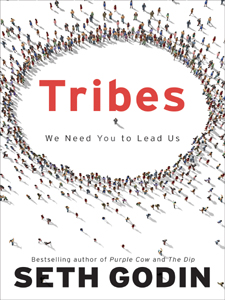
I recently caught up with Seth to discuss his latest book Tribes and how its concepts apply to the music industry.
R&G: What’s your take on the state of the music industry today?
Seth: The music industry is really focused on the ‘industry’ part and not so much on the ‘music’ part. This is the greatest moment in the history of music if your dream is to distribute as much music as possible to as many people as possible, or if your goal is to make it as easy as possible to become heard as a musician. There’s never been a time like this before. So if your focus is on music, it’s great. If your focus is on the industry part and the limos, the advances, the lawyers, polycarbonate and vinyl, it’s horrible. The shift that is happening right now is that the people who insist on keeping the world as it was are going to get more and more frustrated until they lose their jobs. People who want to invent a whole new set of rules, a new paradigm, can’t believe their good fortune and how lucky they are that the people in the industry aren’t noticing an opportunity.
R&G: Are you saying that the technology players like The Hype Machine, Last.fm, MOG or Pandora are taking advantage of the new paradigm?
Seth: I would go to even smaller places. I would talk about the folks who started CD Baby. I would talk about musicians who are making a great living leading a small tribe – 1,000 true fans connecting directly with each other, leaving out many layers of middlemen. I would talk about powerful musicians like Neil Young who are moving things in one direction, versus powerful musicians who are just sitting back and watching the whole thing fade away.
R&G: Can you give an example of a powerful musician or a super-group that’s missing the boat?
Seth: We saw both Metallica and AC/DC take interesting paths when it came time to figure out how to generate new generations of fans, when it came time to play with distribution, etc…
R&G: Going with Best Buy or Wal-Mart?
Seth: Yeah. A Wal-Mart deal seems really sexy, but you’ve got to figure out who you are reaching and what is it doing for you in the long run. Suing your fans is an interesting approach to maintaining the status quo, but there’s no evidence that it leads to long-term benefits. There are musicians who are reaching out and building fan bases and then there are those who are fighting the other direction. I went to see Ricky Lee Jones live in New York City a couple months ago. At the end of the concert they stood up and said, “If we get your email address at the front of the room, we will email you a live recording of tonight’s concert when it’s ready.” 72 hours later, there it was. The idea that you could have a micro-market of 250, 500, 1,000 copies of a CD every night is a totally different way of thinking about what you do for a living, rather than making one album a year marketed with payola and promotion that reaches a certain group of people and ignores everybody else.
R&G: You mentioned “tribes” earlier. Are you referring to “tribes” being the fans of the artists?
Seth: My new book is called Tribes, so I can’t help but use the term “tribe.” I’ve been thinking about it a lot. I define a tribe as a group of people sharing a common culture, a goal, a mission, probably a leader. There are tribes of people – like the ones who go to South by Southwest – who are connected because they want to remake the music industry. There is the tribe of people who follow Bruce Springsteen and will pay unreasonable amounts of money to hear him live and compare playlists. The important distinction here is that music labels used to be in the business of grabbing shelf space, on the radio and in the record store. Now, the music industry needs to realign and be in the business of finding and connecting and leading groups of people who want to follow a musician and connect with the other people who want to do the same.
R&G: I see artists actively pursuing their fans by gathering opt-in mailing lists and offering B-sides and tickets before they go on sale to the general public. I feel like a lot of bands are actively reaching out to their fans.
Seth: Also, the middle geography has disappeared. In the ‘70s or ‘80s you listened to a song because “everyone else” was also listening to it. That’s the definition of pop music. In those days we defined “everyone else” as people in our high school or people who listened to WPLJ. Now, “everyone else” is not defined by where you live or what radio station you listen to. It’s defined by which horizontal or vertical slice of the world you connect yourself with. I might listen to Keller Williams because everyone else in my world includes frustrated Deadheads. We don’t have new Grateful Dead to listen to, so everyone else in my circle is listening to Keller Williams, so he is pop to us. He’s not pop to the kids at the middle school who have never heard of him, right? So you end up with all these silos and niches and lots and lots of ways to look at the world.
R&G: With the a la carte downloads offered by iTunes, eMusic and Amazon, when do you think we’re going to see the death of the album?
Seth: I spend a lot of time hanging out with teenagers, and I’m pretty sure the album is already dead. We bundle stuff up for economic reasons. Movies are the length they are for a reason. Songs are the length they are for a reason. Albums were invented because that’s about as much time as Thomas Edison could put on one piece of recording. But in a digital world, there’s no reason that you can’t have a six-hour product or a three-minute product. So anybody who says it has to be 46 minutes long because that’s how long you can fit on two sides of an LP, I don’t think that’s a good reason to make that your product.
R&G: Do you think that the CD will be a secondary market in the near future?
Seth: Digital is about to surpass the CD, and once it starts to happen it’s going to happen faster and faster and faster. The more interesting thing to me is who is going to control the playlist. If there is an infinite amount of music available – and I would argue that as soon as the amount of music available exceeds the amount of time you have in your life, that’s infinite – somebody will have the leverageable spot of deciding what to listen to next. And it’s unclear whether someone will charge to tell me that or will pay to tell me that. It’s still up for grabs in every one of these vertical silos. Who are the tastemakers and how do these ideas spread? The analogy I like to give is if you’re an author and Oprah Winfrey calls, you don’t say, “How much are you going to pay me to go on your show and give away all the ideas in my book?” In fact, if you could you would pay to be on Oprah. For a really long time the music industry has had two minds: On the one hand, they would pay money to be on Clear Channel or MTV; on the other hand, they would charge you money to hear their music in concert or out of your stereo. Those days are all getting intermingled now. “I am the program director of my radio station, so where’s my payola?”
R&G: Do you see music blogs being a player in the future of whatever the new music business turns into?
Seth: I think they are, and I think the definition of a blog is going to keep changing. Blogs are certainly not what they were seven years ago. They have a totally different look and feel and covenant. The idea of amateur self-published media where everyone can be a writer, that’s here forever. We’re never going to go back to, “No, you must listen. You cannot speak.”
R&G: You’ve written about copyright issues on your blog. DRM is pretty much gone, but with copyright and suing the consumer, what’s your opinion on that?
Seth: It’s really fine and good to have a moral or ethical conversation. I think it’s more productive to have a practical conversation about power. The fact is that the industry will never have enough power to keep someone from pirating something because they think they’re going to end up in jail. The numbers that would end up in jail are too big. They’re probably not going to have enough power to get people not to copy something because they think it will get them in trouble with their mom. After all, it’s an industry built on getting in trouble with your mom. What we’re left with is the argument that if you copy that song, we’ll stop making music. And what the intelligent consumer has noticed is that the amount of music that keeps getting made keeps going up, not down.
R&G: How do managers or do-it-yourself artists stand out in the crowded marketplace?
Seth: It helps if the band is great, if it’s remarkable, and if it’s doing stuff worth talking about. In the old model, what we learned from Schick is that if you come out with a razor just like Gillette but a little cheaper, and you get shelf space, you’ll do fine. Top 40 radio has a long history of being just like the other guy, but with a slightly different song. Just like the other guy, but with better shelf space. That doesn’t work in a totally flat digital world. You only spread if you’re remarkable. Take a look at YouTube videos. If a YouTube video becomes very popular and someone copies it, the new one does not become very popular because it’s just a copy of the old one. I start by saying the music itself – the band, what they’re saying, what they stand for – has to be more than “this is just another version of that.” Also, you have to make it easy for people to speak up. You have to make it easy for people to find each other, to talk about it. You have to create a culture for your tribe. If you go to a Garth Brooks concert and then walk down the street to a Rat Dog concert or a Dead concert, you can tell who’s going to which concert. There’s a culture. There’s a uniform. There’s a code of conduct. You can invent that for your band if you can live it. Inventing it makes sense, because then people know who else is in the tribe.
R&G: When a band brands itself, there is a credibility issue with their fan base; they run the risk of being perceived as a sellout.
Seth: I think the first thing I’d ask is, “perceived as a sellout by whom?” Some people say Patricia Barber is a sellout because she’s a popular jazz musician as opposed to a starving jazz musician. But the people in the crowd don’t think that. I think selling out is largely about expectation, about being transparent and telling the truth to your audience. When The Talking Heads went from being unsuccessful at CBGB to being really successful on MTV and making a movie with Jonathan Demme, some people said they sold out. Other people said they wished they were more pop-like. I’m not sure that’s something that needs to be at the beginning of the conversation. I think that what you have to do is make it clear to your tribe and to yourself what you stand for, and do that.
Further Reading:
Books You Can Buy From Seth (Click Here)
Seth Godin // Music Lessons (Click Here)
Seth Godin // The Live Music Talk (Click Here)
RELATED INTERVIEWS:
ROLLO & GRADY INTERVIEW WITH TERRY MCBRIDE (CLICK HERE)
ROLLO & GRADY INTERVIEW WITH BOB LEFSETZ (CLICK HERE)
ROLLO & GRADY INTERVIEW WITH CHRIS ANDERSON (CLICK HERE)
ROLLO & GRADY INTERVIEW WITH NIC HARCOURT (CLICK HERE)
ROLLO & GRADY INTERVIEW WITH PETER ROJAS (CLICK HERE)
ROLLO & GRADY INTERVIEW WITH GERD LEONHARD (CLICK HERE)
ROLLO & GRADY INTERVIEW WITH ANTHONY VOLODKIN (CLICK HERE)
ROLLO & GRADY INTERVIEW WITH DAVE KUSEK (CLICK HERE)


Comments are closed.